 Works on My GPU
Second post in the "Foundations" series (the first covered GPU architecture generations, Volta to Blackwell). This one is about a question that doesn't have an obvious answer the first time you hit it: NVIDIA already ships cuBLAS, a fast, well-tested matrix multiply library — so what is CUTLASS for, and why would anyone reach for it instead?
The problem cuBLAS doesn't solve
cublasSgemm() is fast. For a plain matrix multiply, it's close to the
best you'll get out of the hardware, and you don't have to think about
tiling, shared memory, or Tensor Core instructions to use it. That's
exactly the problem: it's a black box. You call it, it computes `C = αAB
- βC`, and that's the entire interface.
Real workloads usually want more than that:
- Fusion — bias add, activation function, or a scale-and-clamp applied to the GEMM output, without writing the result to global memory and launching a second kernel to read it back.
- Non-standard data types — mixed precision (FP16 in, FP32 accumulate), INT8/INT4 for quantized inference, or newer formats like FP8, none of which cuBLAS exposes with full flexibility.
- Problem-specific specialization — grouped or batched GEMMs with irregular shapes, or a tile size tuned for one specific, known problem size instead of a generic one.
None of this is available by calling into cuBLAS. To get it, you'd
normally have to write the kernel yourself — and a hand-written GEMM
that actually reaches Tensor Core peak throughput is a genuinely hard
piece of software: multi-level tiling, double-buffered shared memory,
avoiding bank conflicts, and using the right matrix-multiply-accumulate
instruction for the target architecture (wmma, mma.sync, or
wgmma, depending on generation). Most of that work has nothing to do
with your actual problem — it's the same scaffolding every fast GEMM
kernel needs.
CUTLASS (CUDA Templates for Linear Algebra Subroutines) is that scaffolding, factored out into reusable, composable C++ templates — open source, maintained by NVIDIA, and used internally to build parts of cuBLAS itself.
The idea: match the abstraction to the hardware
CUTLASS's core design decision is to decompose a GEMM into layers that correspond directly to the GPU's own execution and memory hierarchy, rather than treating "matrix multiply" as one opaque operation:
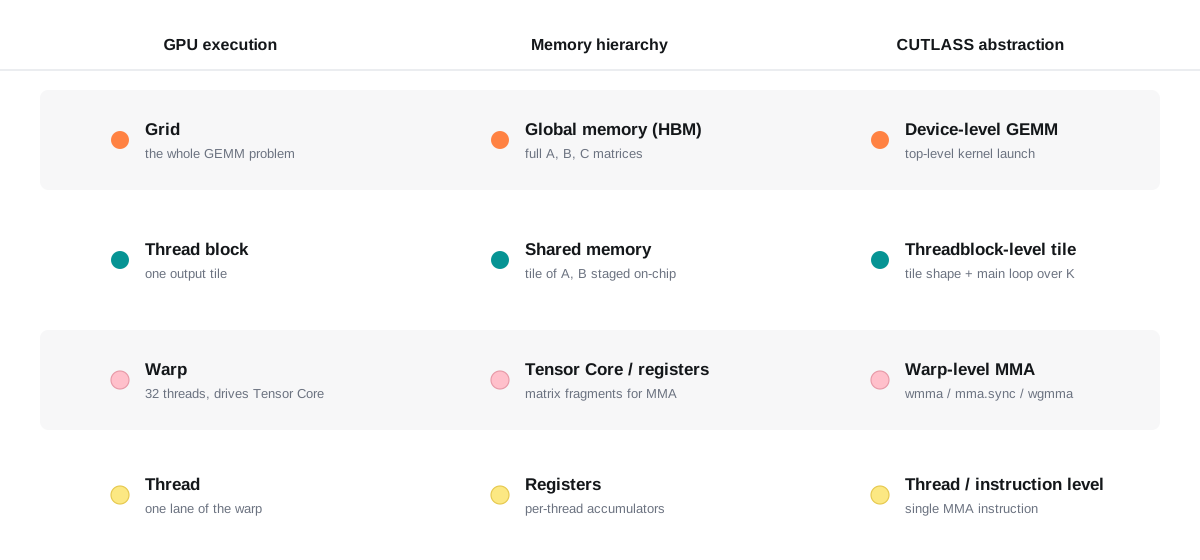
Each row is doing the same conceptual job — computing a tile of the output — just at a different scale, backed by a different part of the memory system:
- At the device level, the whole problem is split into tiles, one per thread block.
- Each thread block cooperatively loads its slice of
AandBinto shared memory, since re-reading from global memory (HBM) for every reuse would be far too slow. - Each warp takes a sub-tile of that shared-memory data and drives the Tensor Core, using matrix fragments held in registers.
- At the thread level, individual lanes participate in the actual MMA (multiply-accumulate) instruction issued by the warp.
This is exactly the tiling discipline any hand-written high-performance GEMM has to implement — CUTLASS just gives each layer a name, a C++ type, and a well-defined interface, so you can swap out one layer (say, the data type or the epilogue) without re-deriving the other three.
What using it actually looks like
At the simplest level — a plain FP32 GEMM with no fusion — declaring and running a CUTLASS kernel looks like this:
#include "cutlass/gemm/device/gemm.h"

using ColumnMajor = cutlass::layout::ColumnMajor;

using CutlassGemm = cutlass::gemm::device::Gemm<
    float,        // data type of A
    ColumnMajor,  // layout of A
    float,        // data type of B
    ColumnMajor,  // layout of B
    float,        // data type of C
    ColumnMajor>; // layout of C

CutlassGemm gemm_operator;

CutlassGemm::Arguments args(
    {M, N, K},       // problem size
    {A, lda},        // source matrix A
    {B, ldb},        // source matrix B
    {C, ldc},        // source matrix C
    {C, ldc},         // destination matrix D
    {alpha, beta});   // epilogue scalars

cutlass::Status status = gemm_operator(args);
CutlassGemm here is a C++ type, not a function — the compiler
generates a specialized kernel for exactly this combination of data
types and layouts at compile time. That's the mechanism behind the
customization CUTLASS is built for: change float to cutlass::half_t
and int8_t, add an epilogue that fuses a ReLU, and the compiler
produces a different, still-specialized kernel — no runtime dispatch,
no black box.
This particular shape of example (plain data types, no fusion) is intentionally the simplest possible one. It's also, not coincidentally, close to what cuBLAS already gives you — the difference only shows up once you start changing the template parameters to things cuBLAS can't express.
CUTLASS 2.x vs. 3.x: the CuTe rewrite
CUTLASS has existed since 2017, and the API above is from its original
(2.x) design. Starting with CUTLASS 3.0, released alongside Hopper,
NVIDIA introduced CuTe — a new core library for describing
hierarchically multi-dimensional layouts of threads and data — and
rebuilt CUTLASS's GEMM kernels on top of it, adding direct support for
Hopper's wgmma instruction and the Tensor Memory Accelerator (TMA)
for asynchronous bulk data movement.
The hierarchy in the diagram above didn't change between 2.x and 3.x — device, threadblock, warp, and thread are still the levels a GEMM gets decomposed into. What changed is how each level's tile is described: CuTe replaces a set of fairly rigid, generation-specific template classes with a small, composable algebra of shapes and strides that works uniformly across architectures. That's specific enough to be its own post — next in this series.
Why this is worth knowing before writing any kernels
CUTLASS is a big, actively-developed codebase, and it's easy to treat it as something to copy-paste from rather than understand. The one idea worth taking away from this post: every abstraction layer in CUTLASS exists because it corresponds to a real, physical layer of the GPU. When something about CUTLASS's API feels arbitrary, it usually isn't — it's tracking a hardware boundary (a memory space, a synchronization scope, an instruction granularity) that any fast kernel has to respect, CUTLASS or not.
References
- NVIDIA/cutlass — official GitHub repository
- CUTLASS: Fast Linear Algebra in CUDA C++ — NVIDIA Technical Blog
- CUTLASS 3.x: Orthogonal, Reusable, and Composable Abstractions for GEMM Kernel Design — NVIDIA Technical Blog
- NVIDIA CUTLASS Documentation — Overview
- Code example adapted from CUTLASS's own
examples/00_basic_gemmin the repository above.
Hierarchy diagram above is original artwork made for this post.