 Works on My GPU
Seventh GPU Deep Dive post, closing a thread that's been open since Continuous Batching: "naively slotting a freshly arrived request's prefill into the same iteration as a batch of decode steps can spike that iteration's latency for every other request sharing it." Disaggregated serving — DistServe, Splitwise, and Mooncake all converge on roughly the same answer — doesn't tune that tradeoff. It removes it: prefill and decode run on entirely separate GPUs, so the two phases never compete for the same batch slot again.
The tension, restated
Prefill (processing a new prompt, all at once) and decode (generating one token, for an already-running request) have opposite resource profiles: prefill is compute-bound — one big matrix multiply over the whole prompt, good GPU utilization — while decode is memory-bandwidth- bound — one token, mostly waiting on loading weights and KV cache from memory. Continuous batching schedules both phases' work onto the same GPU, in the same iteration, because that's how it keeps utilization high. The cost: a long prefill sharing an iteration with a batch of decode steps makes every one of those decode steps wait for the prefill's far larger compute job to finish first, directly hurting token-to-token latency for requests that were already running smoothly.
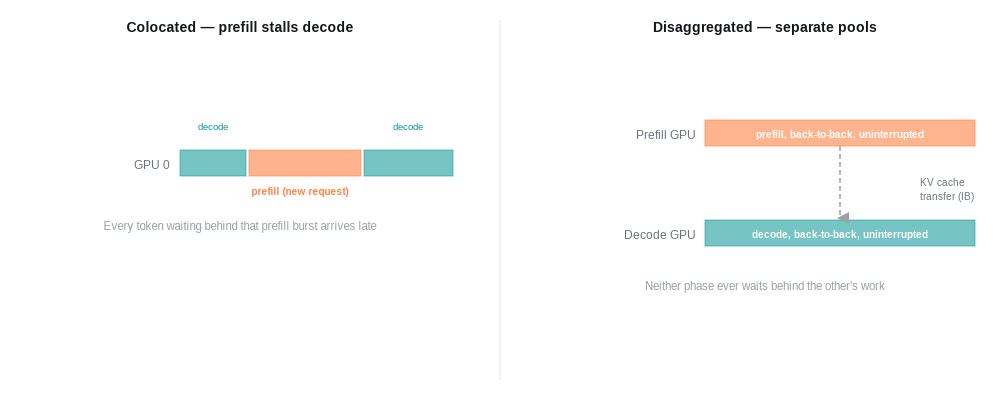
The fix: don't share the GPU at all
DistServe (Zhong et al., OSDI 2024) puts it plainly: colocating the phases causes "strong prefill-decoding interference," so its design "assigns prefill and decoding computation to different GPUs, hence eliminating prefill-decoding interferences" outright. Once a prompt finishes its prefill pass, its KV cache is transferred over the network to a GPU in the decode pool, which then generates tokens for it uninterrupted by anyone else's prefill, ever. DistServe then "co-optimizes the resource allocation and parallelism strategy tailored for each phase" — prefill and decode GPUs don't even need to be configured identically, since they're now running structurally different workloads.
Measuring success differently: goodput, not throughput
Raw throughput (tokens/sec) hides a real problem: a system can post good aggregate numbers while badly violating individual requests' latency targets. DistServe instead optimizes for goodput — the maximum request rate a GPU can serve while meeting both a time-to-first-token (TTFT) and a time-per-output-token (TPOT) target — and reports that disaggregation lets it serve 7.4x more requests or meet a 12.6x tighter SLO than prior state-of-the-art systems, while keeping over 90% of requests within their latency constraints. The paper also places prefill and decode pools according to the serving cluster's actual interconnect bandwidth specifically to minimize the communication cost disaggregation introduces.
Different phases, different hardware
Splitwise (Patel et al., ISCA 2024, Microsoft Research) pushes the same split a step further: since decode is memory-bound, not compute-bound, it "does not need the compute capability of the latest GPUs and can be run with lower power and cost." That means a Splitwise cluster doesn't have to use identical GPUs for both pools — prefill can run on newer, more powerful hardware while decode runs on cheaper, lower-power GPUs, and the KV cache moves between pools over the cluster's InfiniBand back-plane. The paper reports clusters designed this way achieve up to 1.4x higher throughput at 20% lower cost, or alternatively 2.35x more throughput under the same power and cost budget as a non-disaggregated design. It also describes a third mixed pool that expands and contracts with demand, running ordinary continuous batching for whichever requests the two dedicated pools can't currently absorb — disaggregation isn't necessarily all-or-nothing across a whole cluster.
Treating the KV cache itself as the thing being served
Mooncake — the architecture behind Moonshot AI's Kimi — goes one step further again: instead of just moving KV cache between a prefill pool and a decode pool, it treats KV cache as its own disaggregated resource, spread across the cluster's otherwise-underutilized CPU, DRAM, and SSD capacity, not just GPU memory. Its scheduler balances maximizing effective throughput against meeting latency SLOs, and under overload it uses a prediction-based early-rejection policy — refusing a request up front rather than accepting it and then blowing its latency target later. Mooncake reports up to a 525% throughput increase in simulated scenarios while still meeting SLOs, and in actual production serving for Kimi, the architecture lets the same cluster handle 75% more requests.
What disaggregation costs
None of this is free. Every disaggregated request now pays a KV cache transfer over the network between its prefill and decode GPUs — real latency added to TTFT, bounded by how good the cluster's interconnect is, which is exactly why DistServe explicitly places pools according to measured bandwidth and Splitwise leans on InfiniBand specifically for the transfer. Disaggregation also needs enough total GPUs to make running two differently-shaped pools worthwhile in the first place; at small scale, a single pool doing plain continuous batching can simply be the better tradeoff. This is consistent with the whole run of Deep Dive posts on this blog: every fix — FlashAttention (kernel), FP8 WGMMA (register layout), PagedAttention (memory allocation), continuous batching (scheduling), expert parallelism (cross-GPU communication), and now disaggregated serving (deployment topology) — targets a real bottleneck at its own layer, and none of them make the others unnecessary.
References
- DistServe: Disaggregating Prefill and Decoding for Goodput-optimized Large Language Model Serving — Zhong et al. (OSDI 2024)
- Splitwise: Efficient Generative LLM Inference Using Phase Splitting — Patel et al. (ISCA 2024)
- Mooncake: A KVCache-centric Disaggregated Architecture for LLM Serving
Timeline diagram above is original artwork made for this post.